Showing posts with label General: Investments. Show all posts

25 September 2008

Taiwanese Firms Investing in China

Here at Hi Tech Taipei I have long argued Taiwanese companies should be careful about migrating their latest technologies to China. President Ma Ying Jeou believes enabling companies to invest in China and specifically migrate their latest technologies to China will enable those companies to remain competitive. I am not so sure.

We noted objections to moving 45 nm fabs to China in Mr. Ma please don't move the fabs to China. We also argued in China Strategy for Fabless Chip Designers that design companies should be careful about partnering with Chinese companies because their intellectual property may be at risk. In Hon Hai Fights in Shenzhen we observed how Taiwan's largest contract manufacturer is struggling to maintain its intellectual property rights from marauding Chinese pirates. In the article quoted we observed how the Chinese legal system may be complicit in the piracy by not accelerating the case and enabling Hon Hai's competitor to gain traction in the market.

However, in No 10G AUO Plant in China we conceded any investment decision into China will be a business decision and not a political one and were also pleased to note both AU Optronics (AUO) and (in Fabs to Stay in Taiwan) the big Taiwanese foundries UMC and TSMC were going to stay invested in Taiwan.

To follow up Digitimes has posted an excellent commentary on the issue of Taiwanese firms investing in China. The beginning of the commentary is quoted below.

Since Taiwan's new president took office in May this year, the government has promised to relax various restrictions on its ties and exchanges with China. Taiwan's semiconductor and flat panel industries are now eagerly awaiting changes to the investment rules that have prevented companies from setting up operations involving advanced technologies in China.

President Ma Ying-jeou has on several occasions spelled out the principles for lifting the China-bound investment restrictions. First, after the restrictions are eased, Taiwan's IT industry can remain competitive globally, and its share of global market for IC and semiconductor will not be affected. Second, the advanced technologies developed by Taiwan players and their intellectual property must be well protected in China.

Signs in the market have indicated that an announcement from the government is expected in September.

The article is well worth the read. Follow the link below.

Digitimes: Taiwan and restrictions on China-bound investments
27 August 2008

ASUSTek Added to Dow Jones Technology Titans Index

The Street Insider reports ASUSTek will replace Electronic Data Systems Corp on the Dow Jones Technology Titans 30 Index. ASUSTek joins three other Taiwanese companies in the index. The three others are Taiwan Semiconductor Manufacturing Corporation (TSMC), High Tech Computer Corporation (HTC) and Hon Hai Precision (Hon Hai). There are now four Taiwanese companies listed on the index. Only the New York Stock Exchange and the NASDAQ have more companies represented. A full list of companies on the index is below:

  • Alcatel-Lucent (Paris)

  • Apple (NASDAQ)

  • Applied Materials (NASDAQ)

  • ASUSTek (Taiwan)

  • Canon (Tokyo)

  • Cisco Systems (NASDAQ)

  • Corning (New York)

  • Dell (NASDAQ)

  • EMC (New York)

  • Fujitsu (Tokyo)

  • Google (NASDAQ)

  • Hewlett-Packard (New York)

  • HTC (Taiwan)

  • Hon Hai (Taiwan)

  • Intel (NASDAQ)

  • IBM (New York)

  • LM Ericcson (Stockholm)

  • Microsoft (NASDAQ)

  • Motorola (New York)

  • Nokia (Helsinki)

  • Oracle (NASDAQ)

  • Qualcomm (NASDAQ)

  • RIM (Toronto)

  • Ricoh (Tokyo)

  • Samsung (Korea)

  • SAP (XETRA)

  • TSMC (Taiwan)

  • Texas Instruments (New York)

  • Xerox Corp. (New York)

  • Yahoo! Inc. (NASDAQ)

The presence of four Taiwanese companies on this index is another indicator of their dominance of the global tech sector beyond the United States. Japan only has three companies represented and Korea one.

Street Insider: Component Change Made to Dow Jones Technology Titans 30 Index

21 August 2008

Taiwan Companies Return to List in Taiwan

The Wall Street Journal has an interesting article on Taiwanese companies returning home to list on the Taiwan Stock Exchange. The WSJ writes:

Taiwan's new government is close to winning some important victories in its effort to revitalize the island's stock market, as several Taiwanese companies that had gone public overseas are now considering listing at home.

Ju Teng International Holdings Ltd., which makes notebook-computer casings and has been listed in Hong Kong since 2005, said its board will decide before the end of the month whether to make a public offering on the Taiwan Stock Exchange or to issue depositary receipts instead.

Other companies say they are considering a Taiwan listing, including Delta Networks Inc., an original design manufacturer of network-communications equipment that also trades in Hong Kong, and Ta Yang Group Holdings Ltd., which makes input devices such as keyboards and keypads for computers, mobile phones and autos.

Taiwan has set a goal of attracting 200 companies to the local exchange. "It is encouraging to see companies looking into the option of using Taiwan's stock exchange as a platform for capital-market operations," said Tao Dong, Credit Suisse's chief regional economist for Asia, who once predicted Taiwan's stock market would be marginalized in a few years.

The effort got a boost earlier this month. Taiwan's Hon Hai Precision Industry Co., the world's largest contract electronics maker by revenue and a maker of Apple Inc.'s iPods and other electronics, said it plans to list its overseas units on the Taiwan Stock Exchange. With the public listing of its Foxconn International Holdings Ltd. unit on Hong Kong three years ago, Hon Hai was one of the first Taiwan companies to turn to Hong Kong, where about 60 Taiwan companies are traded.

Warming relations with China have proved a potent lure home. Taiwan President Ma Ying-jeou, who took office in May, has eased investment restrictions that made it tricky for Taiwan-traded companies to keep significant operations in the mainland. That could help Taiwan's efforts to become a regional financial hub as it ties the island's fate closer to the mainland's.

The WSJ continues saying:

The performance of Taiwan's exchange has trailed behind that of others. Hong Kong's benchmark Hang Seng Index nearly doubled between 2005 and 2007, while the benchmark Shanghai Composite Index rose fourfold. Over the same period, Taiwan's benchmark Weighted Price Index rose about 39%. As of March, Taiwan's exchange had 712 listed companies, compared with Shanghai's 861 and Hong Kong's 1,244, according to recent research published by the Hong Kong Securities and Futures Commission.

Taipei's new policy raises the ceiling on China investment to 60% of corporate net worth. It also allows companies in which Chinese shareholders own 20% or more to list on Taiwan's exchange and abolishes a rule banning foreign companies from investing in China with locally raised funds.

Many of the Taiwanese companies exploring a domestic listing are frustrated with their stock-market valuations elsewhere. "Compared with our Taiwanese counterparts, our P/E in Hong Kong is really low," said Huang Cheng-pin, a Ju Teng spokesman. The company's P/E ratio has been about seven, while its Taiwanese counterparts have P/E ratios of about 15 on the local stock market, he said.

First up I will say its good for Taiwanese companies to list in Taiwan and that this may stimulate the local bourse and keep it competitive in the region. Taiwan has stated before they do want to become a financial hub and having more companies listed on the exchange may go a long way to helping the local stock exchange and the financial sector.

However, I find the comparison between the Hang Seng and the Shanghai stock exchange overly simplistic. The comparison is only made between 2005 to 2007 when most observers agreed the Chinese stock market was being fuelled mostly by speculation with share prices for some companies much higher than any potential future revenue. It just seems crazy to compare the two markets.

How about recent history? the Shanghai Index (SSE) has declined from 5261 in January to 2431 on 21 August. This is a 53% drop in value. On the other hand, the Taiwan Weighted Index (^TWII) has dropped from 8184 to 6918 yesterday. A drop of only 15% on the year. Both indicies may go down further but the point being made is that much of the four-fold increase in the Shanghai Stock market was speculative no substantive. The Hang Seng index is down from 27,560 to 20,392, which is a 26% decrease. On the year we should say the Taiwan index is doing better than the other two indicies, but then this would be a little too simplistic as well.

I also suspect there are also other forces driving the index movements. The underlying shares on the index are certainly very different in each case and the exposures they have will also vary significantly. The global context of the markets and the underlying forces for the predominant businesses represented in the indexes should be properly analyzed before people make superficial comparisons based on price.

What I did like to see was that the companies were being honest about why they want to come back to Taiwan. A higher P/E ratio is better for the share price (see Wikipedia page). However, the government has also for a while now been trying to attract Taiwanese companies back to Taiwan. We already noted this in Taiwanese Investment in China: Now and the Future. What might be good for the economy is that if the companies do list in Taiwan, they might be more prepared to put more of their operations on the island and thereby stimulate the job market.

Any investments back in Taiwan will be good for the economy and more listings on the exchange may help stimulate the financial sector in Taiwan too.

Wall Street Journal: Taiwanese Companies Consider Home Listing

Stock Prices Drop

With the exception of two, all companies listed on the TSEC Taiwan Technology Index saw declines in their share price today. Only the share prices for Compal (2324.TW up 0.32%) and Inventec (2356.TW stayed the same) didn't go down. The decline in tech company share prices followed the Taiwan Weighted Index (^TWII) down. The TAIEX went down 1.74% to close at 6918.48.

Other markets in the region followed suit. The Hang Seng (^HSI) lossed 2.58% of its value, the Korean KOSPI (^KS11) fell 1.83%, the The NIKKEI225 (^N225) went down 0.77% and the NIKKEI300 (^N300) went down 0.68%.

In Silliness is.....The Chen Scandal and Declining Share Prices we noted how the China Post attributed the Monday decline in the TAIEX (^TWII) to the Chen Shui Bian scandal. What I did miss was that Forbes, a publication I think is pretty good, also jumped in on blaming the ex-president's money laundering scandal for the decline in Monday's stock prices (see Chen's Apology Rocks Taiwanese Financials, hat-tip The View from Taiwan). Hopefully such silly assertions won't be in the press tomorrow.

I personally suspect an increase in the oil price to US$116 per barrel may be responsible for the declines (see Oil rises in Asia on falling US gasoline supplies). But with the stock market who ever really knows?

[Link: TSEC Taiwan Technology Index stock prices here @ http://finance.yahoo.com/p?k=pf_14]

12 August 2008

TSMC to buy back stock and Gvt. to Retain Shares

Reuters reports the TSMC board has agreed to buy back a significant number of shares. Reuters writes:

TSMC (2330.TW: Quote, Profile, Research, Stock Buzz), the world's biggest contract chip maker, said on Tuesday its board has approved a plan to buy back up to T$16.5 billion ($529 million) worth of its shares from the open market.

Taiwan Semiconductor Manufacturing Co Ltd (TSMC) (TSM.N: Quote, Profile, Research, Stock Buzz) plans to buy back shares at a price in the range of T$42.85 to T$86.20 per share from Aug. 13 to Oct. 12, and cancel the repurchased shares, the company said in a statement.

"The sole purpose of this buyback is to remove partially the dilution from employee profit-sharing," TSMC Chief Financial Officer Lora Ho said in the statement.

The announcement came after the Taipei stock market closed on Tuesday, when TSMC shares rose 1 percent, defying a 0.4 percent fall on the main TAIEX .

"This repurchase program is separate from the multi-phase plan with Philips, and Philips will not use this program to dispose of its remaining stake in TSMC," Ho said.

Philips Electronics NV has said it planned to accelerate the sale of its remaining stake in TSMC.

The only debate here is should I wake up my wife and tell her to buy shares as soon as the market opens? Probably not! I guess their share price will jump today. Right now its sitting at NTD61.2. We will see at 1:30pm today what effect this buy back program has on their shares. Knowing Taiwan it will push the price up. People get excited by news like this.

Reuters has also reported Taiwan's state fund will keep their TSMC shares through 2009. Reuters reports:

Taiwan's state-owned National Development Fund plans to hold its shares in chip maker TSMC next year, because it has no need to raise extra cash for state coffers, a top official said on Tuesday.

"Next year's budget has been presented to the Executive Yuan (cabinet)," James Ho, deputy executive secretary of the development fund, told Reuters.

The development fund is set to contribute T$6.4 billion ($205 million) for state coffers in 2009, compared with this year's budget of between T$11 billion and T$12 billion, he said, without elaborating on the shortfall.

Despite all this news, TSMC's share price dropped 0.37% on the New York exchange. I guess the buy back program will only include shares on the Taiwan exchange and the shares owned by the government are held in Taiwan and not New York. Watching the price on the Taiwan Stock Exchange today will be interesting.

Reuters: TSMC to buy back up to T$16.5 bln of own shares
Reuters: Taiwan state fund to hold on to TSMC stake in 09

15 July 2008

Taiwan Technology Index - 15 July, 2008

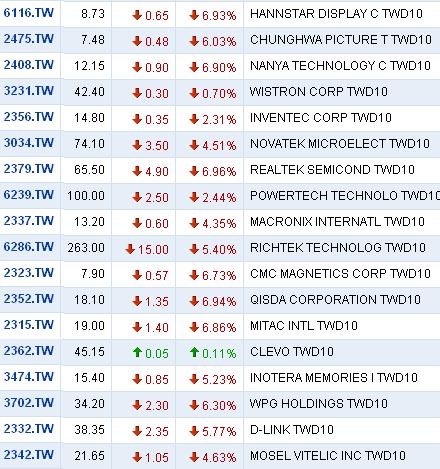
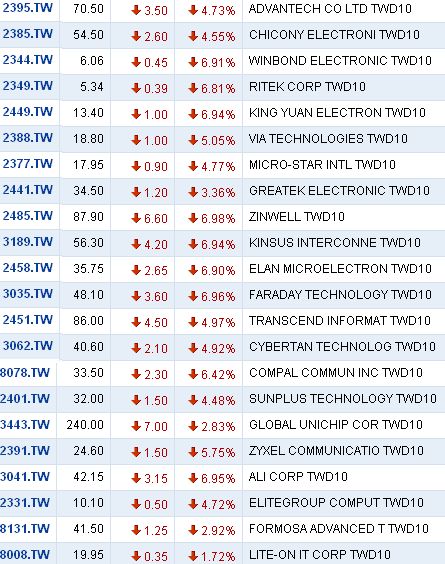
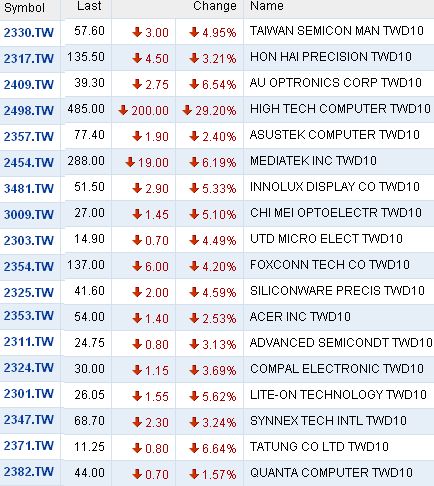
Today the Taiwan Technology Index bleeds red! Everything is down except Clevo who made a marginal gain. Remember in our post earlier today we spoke about the stock market continuing to decline! Sure, tomorrow anything can happen, but I think it will go down more. I don't see any good news on the horizon. See the picture below. Grabbed it from my Yahoo portfolio for the Taiwan Technology Index. Stocks are cheap now. Maybe they will become cheaper!


20 May 2008

10% of Mainland Investments Remitted to Taiwan

Forbes reports 10% of all money invested in China by Taiwanese companies is remitted back to Taiwan. Forbes reports:

Companies listed on the Taiwan Stock Exchange and GreTai Securities Market had remitted home earnings equivalent to 10.30 pct of their cumulative investments in China as of the end of the first quarter to March, the Financial Supervisory Commission said.

The FSC could not pinpoint a starting point for the tallies as they take into account investments made by companies before and after their listings.

As of the end of March, listed companies had brought home from the mainland a cumulative, combined 73.9 bln twd, up by 10.3 bln from the end of 2007, it said.

The companies had cumulative, combined investments on the mainland of 717.6 bln twd as of the end of March - down by 14.5 bln from end-2007.

Of course there has been ongoing debate in Taiwan about the benefits accrued in Taiwan by investing in the Mainland. Many people here feel that this negatively impacts Taiwan's economy as it takes jobs away from Taiwanese people. As an example, many taxi drivers I speak to are ex-employees of companies that moved to the mailand and are bitter that there were no jobs for them. However, the structure of Taiwan's economy is changing and has been changing over the past few years. A 2006 Taiwan Review article noted:

According to the Directorate General of Budget, Accounting and Statistics of the Executive Yuan, in 1981 the service sector accounted for 47.23 percent of Taiwan’s GDP, while the industrial sector did so for 45.47 percent, 90 percent of which was manufacturing. In 2005, services had beefed up to 73.5 percent of GDP, nearly the same as those of developed countries like Germany and Japan, and it is expected to reach 76 percent by 2015.

It is true that many people in the manufacturing sector have lost their jobs. But the younger generation are finding more employment opportunities in the service sector or non-manufacturing based industries (e.g. IC design). Financial Services are another area where people are finding more opportunites. The China Post reported that Taiwan is aiming to become Asia's financial center. The China Post said:

The Economic Daily News quoted Chen Shu, director-general of the Financial Supervisory Commission, as saying that after incoming President Ma Ying-jeou's government is inaugurated Tuesday, he will give priority to building Taiwan into the Asia-Pacific financial center.

"During my four-year term, I will draft short-term, mid-term and long-term plans for building Taiwan into the Asia-Pacific financial center," the paper quoted Chen as saying.

Even if Taiwan doesn't manage to become Asia's financial center, the service sector opportunities are growing and, any money remitted to Taiwan from their investments on the mainland should be beneficial to the economy.

Article 1: Taiwan listed cos remit home 10.30 pct of cumulative China investments as of Q1
Article 2:
Serve It Up!
Article 3:
Taiwan sets sights to be a financial center

Taiwanese Chip Assemblers Investing in China

Powertech Technology Inc. and Advanced Semiconductor Engineering Inc. (ASE) have both been granted permission by the Ministry of Economic Affairs (MOEA) to fund investment projects in mainland China. China Economic News (CENS) says:

With the permission, Powertech will invest US$100 million to open a brand-new test and packaging factory in southern or central China to keep up with rising demands from memory-module maker Kingston Technology and other customers in the mainland.

ASE is ratified to put US$90 million into expanding an operating factory in Shanghai to keep it advantageous in the intensifying competition in the mainland`s test and packaging market.

However, in return for receiving permission to invest in the mainland, both Powertech and ASE have pledged to invest significant sums back into Taiwan. CENS says:

Powertech pledges to invest NT$8 billion (US$266 million at US$1:NT$30) over next few years to boost capacity at a factory in northern Taiwan, which was completed early this year, and increase 1,000 jobs. Also, MOEA officials said Powertech planned to inject NT$20 billion (US$666 million) into Taiwan`s operations and create 2,000 jobs in next stage of its investment plan.

For ASE, the commitment as return for government permission is to put a total of US$550 million into Taiwan`s operation and increase high-ranking jobs for Taiwanese talents over next three years.

Both companies seem to be convinced they need to invest in China. Powertech argues many of their companies are located there and to be able to service their needs they need to be closer. Whatever the reason, this investment, in the short term at least, seems to be a win-win for both the Mainland and Taiwan.

I am sure over the next few months we will see more and more Taiwanese chipset makers and assemblers investing in China. Previous legislation prevented them from doing so as there was a fear that the high-tech knowledge of these companies would be used in Chinese military applications against Taiwan. The new president Ma Ying Jeo has said he will provide more flexibility to chipmakers and follow the US government guidelines on what technologies can be manufactured in China.

Article: Two Taiwanese Chip Assemblers Approved to Invest in China

23 April 2008

WiMAX Explosion in Taiwan

Yesterday we noted Intel's commitment to investing US$500 million in Taiwan's WiMAX industry. Apparently the commitment is even deeper than that. Intel are also committing to entering in joint ventures with Taiwanese companies to develop broadband networks on the island. China Economic News (CENS) has more:

Intel will spend US$500 million over the next five years ending in 2013 on its WiMAX investment and procurement of the equipment in Taiwan, in addition to its original pledge to invest an undisclosed amount of capital to open WiMAX joint venture in Taiwan, according to an Intel top executive.

Intel Executive Vice President Sean Maloney noted the procurement items would include WiMAX chips and consumer premise equipment. Taiwanese suppliers likely to benefit from the procurement deal include MediaTek Inc., Faraday Technology Corp., GemTek Technology Co., Ltd., D-Link Corp. and Zyxel Communications Corp.

In reaction, CENS reports that President elect Ma Ying Jeo has committed to attending the WiMAX trade show to be held in Taiwan in June. In the same article CENS reports Intel has opened a WiMAX office in Taiwan and also notes the following observations:

Taiwanese industry watchers estimate the latest and previous commitments to cost Intel around NT$20 billion (US$666 million at US$1:NT$30) in investment capital.

The joint venture will assess plans to put money into Taiwanese network-communications equipment makers and WiMAX-service providers. Taiwanese companies of both sectors reported to receive the investment capital include GemTek, D-Link, Tatung InforComm Co., Ltd., First International Telecom Co., Ltd., and Global Mobile Corp. However, Intel said it was still assessing.

In a separate article CENS observes that the Taiwan government is trying to get 8 million on-island WiMAX subscribers during 2008. According to CENS:

Taiwan has been actively engaged in developing WiMAX (worldwide interoperability for microwave access) network technology, and planned to have a total of 8 million users of services based on the technology by the end of this year, according to Chen Chao-yih, director general of Industrial Development Bureau (IDB) under MOEA.

PC manufacturers are also getting on this bandwagon. Digitimes noted yesterday that Acer is currently testing WiMAX enabled notebooks that they hope to launch in June. The notebooks will be based on the fifth-generation Centrino code-named Montevina.

WiMAX is going to change the world no doubt. It provides added wireless convenience and enables easy connectivity over long distances. One wonders though what the packages will be like. The push towards WiMAX in Taiwan is not surprising. Under now president elect Ma Ying Jiou Taipei became the worlds first wirless city in 2006 with thousand of Wi-Fi nodes distributed throughout the city. However, as noted by the New York Times, the system had a very low adoption rate in the beginning. Of course WiMAX's big advantage is the bandwidth and the speed with which data can be dowloaded. But still, how will it be packaged?

Article 1: Intel Pledges to Up Ante On Taiwan`s WiMAX Biz
Article 2: Taiwan Aims to Attain 8 M. Users of WiMAX in 2008
Article 3:
Acer to launch WiMAX-enabled Montevina-based notebooks in June-July
Article 4:
What if They Built an Urban Wireless Network and Hardly Anyone Used It?
Website 1: WiFly Website
Website 2:
WiMAX Show Website

21 April 2008

Quanta and ACER get behind WiMAX

Recently Digitimes noted the formation of a WiMAX consortium here in Taiwan. According to Digitimes:

Four Taiwan WiMAX licensed operators – Global Mobile, Vastar Cable TV System, Tatung Telecom and First International Telecom (Fitel) – on April 15 formed the Consortium of Mobile Broadband (CMB) with an aim to facilitate the development of the WiMAX industry in Taiwan.

China Economic News (CENS) reported shortly thereafter that Taiwanese PC manufacturers are supporting the WiMAX standard. CENS reported:

Taiwan's top two PC makers-Acer and Quanta Computer-recently joined the island`s telecom providers to form an alliance christened "Consortium of Mobile Broadband (CMB)" to promote WiMAX technology.

The article continues:

Industry watchers on the island said the allying suggests that makers of network-communications equipment PC makers have emerged as another major force pushing the formation of the next-generation mobile industry in Taiwan.

Intel has is also getting behind the development of WiMAX in Taiwan. Reuters reports:

Intel Corp said on Monday it will invest $500 million in Taiwan over the next five years, with a large amount of the investment targeted at the island's WiMAX sector.

As I also noted last week, at the top of NEC's procurement list were WiMAX components. WiMAX is growing in Taiwan.

Article 1: Taiwan licensed WiMAX operators form consortium
Article 2: Taiwanese PC Makers Join WiMAX Camp
Article 3: Intel to Invest $500M in Taiwan to Boost WiMAX
Previous:
NEC to Purchase Components Worth Three Billion USD
About WiMAX:
WiMAX Forum, Wikipedia

Taiwanese Firms Moving to Vietnam

China Economic News (CENS) continues to update on Taiwanese firms moving to Northern Vietnam. (See Vietnam the new Promised Land) In an article posted Friday (April 18) CENS says:

To ease the impact of skyrocketed production costs in mainland China, Taiwanese firms operating there, including those form the electronics and conventional industries, are rushing to move operations to northern Vietnam.

The relocation move such leading electronics as Hon Hai Precision Industry Co. and Compal Electronics Corp. is expected to encourage more Taiwanese firms to do so in the second half of this year. Taiwan`s top-five electronics firms have all set up production facilities in the northern part of Vietnam.

However, all this movement is pushing up property price in Vietnam, especially in Hanoi. The article says:

...the average land price for some industrial zones in northern Vietnam is set at 200,000 renminbi per acre, quite the same as those located in eastern and southern parts of mainland China.

I am sure we will hear more about this as time goes by. However, one should imagine that rising costs in Vietname will eventually force many companies to return to Taiwan or to expand elsewhere. I personally believe this is good for Vietnam. Much of the success of Guangdong Province in South China can be attributed to the massive investment from Taiwanese firms there. Perhaps Vietnam can reap the same benefits and their people can have an improved quality of life.

Article: Taiwanese Firms Switch Operations to Northern Vietnam From Mainland China
Previous Coverage: Vietnam the new Promised Land

17 April 2008

NEC to Purchase Components Worth Three Billion USD

The government website Invest in Taiwan (IIT) reports NEC, Japans largest computer manufacturer, will purchase more than USD3 billion worth of components from Taiwan, second behind Sony. Their largest procurements will be of WiMAX components. IIT says:

At the top of NEC's procurement list were WiMAX components such as broadband and network peripherals, surpassing notebook computers for the first time ever as the top procurement item, said NEC Taiwan general manager Akira Kubota. NEC has also set a procurement goal of USD 3 billion for the new fiscal year, which starts in April, he said.

Additionally, NEC has set already setup a WiMAX R&D center in Taiwan and will also focus on selling more products into the Taiwan market.

Kibota (NEC Taiwan GM) said that with the new fiscal year, NEC Taiwan will place equal focus on selling hardware and introducing its SI solution to the Taiwanese market. The company's customer targets will be Taiwanese government agencies, financial institutions, the retail sector, IT industry, and the manufacturing sector; the company also plans to introduce a version of its SI solution for the tourism industry, specifically to European and US-run five-star hotels, he said.

Article 1: NEC procurement in Taiwan to reach USD 3 billion this year, plans to market SI solution

14 April 2008

Forex Effect on Taiwan Companies

More on foeign exchange. Digitimes reports that Motech Industries, a solar cell manufacturer, have suffered an erorosion in their Q1 profits due to a strengthening NT dollar. Digitimes reports:

Motech Industries reported unaudited net profits of NT$239 million (US$7.88 million) in the first quarter of 2008, an amount that was severely eroded by exchange rate losses.

Motech posted gross operating profits of NT$819 million (US$27 million) and non-consolidated income of NT$666 million in the first quarter of 2008. Net profits for the first quarter was NT$239 million. The company's gross margin shrank from 17% to 16.7% due to expenses from employee bonuses. Earnings per share (EPS) was NT$1.16.

Industry watchers noted that Motech is still having consistent sales growth, as evident in its quarterly sales of NT$4.9 billion. However, the rapid appreciation in the New Taiwan (NT) dollar against the US dollar, as well as an inefficient currency hedge policy, led to a booked exchange loss of NT$400 million. The exchange loss stemmed from unused global depository receipts (GDRs), as well as deposits for material procurement, the company explained.

The China Economic News (CENS) also notes that strong appreciation of the RMB in China will force many China-based Taiwan enterprises to close. CENS reports:

Sharp appreciation of renminbi is expected to trigger a major shakeout among Taiwanese-invested enterprises in China, possibly forcing one third of Taiwanese firms in traditional lines to close shop, while allowing those with solid strength to land even more orders in two years later after experiencing the ordeal this and next year, said Lin Chin-chang, chairman of the Humen branch of the Taiwanese Chamber of Commerce in Dongguan, Guangdong Province, yesterday (April 10).

CENS continues,

As a result, Taiwanese firms in Dongguan area may fold at a rate of 20-30 per month, up from 2-3 last year, according to Lin. Xie Qingyuan, vice chairman of Taiwanese Chamber of Commerce in Donggouan, noted that Taiwanese makers won`t be able to take any order should renminbi`s exchange rate climb to US$1=6.5 yuan.

Hopefully some of these companies will survive. Especially hard hit will be the textile industries. Maybe they can hold firm in this economic shake-up.

Article 1: Motech net profits eroded by exchange losses in 1Q08
Article 2: Numerous Taiwanese Firms in China Likely to Fold on Sharp Revaluation of Renminbi

13 April 2008

Vietnam the new Promised Land

With rising labor costs in China and a reduction of tax incentives, Taiwanese companies are increasingly looking to other places to setup manufacturing plants. CENS reports that most large Taiwanese EMS (Electronic Manufacturing Services) are moving to Vietnam where labor costs are 40% to 50% lower than in China. These companies inlcude Hon Hai Group, Compal Electronics Inc. and Wistron Corp., who, according to CENS, "have gradually moved to build production plants there, according to company sources."

(Article Link: Taiwan`s Leading EMS Makers Move to Set up Production Lines in Vietnam)

08 March 2008

Taiwanese Investment in China: Now and the Future

Over the years Taiwan corporations have continued to remain competitive by moving manufacturing operations to low cost countries like China, Vietnam, Thailand, and Cambodia etc. However a large bulk of these investments have been into China.

Between 1991 and 2007, Taiwan approved US$65 billion worth of investments in China and probably much more in unreported investments. Last year alone investments from Taiwan into China amounted to US$10 billion. In December alone investments had a 22.6% year on year increase to US$1.52 billion. (Source: Reuters)

Many of the hi-tech companies have invested in manufacturing plants since this is their strength. The whole chain of sourcing raw materials, product design, marketing, manufacturing and supply chain management is highly integrated in the Taiwan market, and Taiwanese companies do it well. However, with many of these companies moving their manufacturing operations overseas, much of their expertise has been transferred. These movements, and the dependency on China as the low cost manufacturing base, has long concerned the Taiwan government, who would prefer these corporations diversify their investment strategies by sharing the investments among the other countries.

This level of investment has also led to a loss of manufacturing jobs and a decline in manufacturing in Taiwan. Last year (or the year before, cannot remember) I read in the Taipei Review that over the past decade the structure of Taiwan’s economy has changed significantly. The service industry is a growing sector and contributing more and more to the economic well being of the island. Some local restaurants and bookstores were even expanding internationally.

However, the loss of jobs is a concern. To help stimulate reinvestment into Taiwan, the government recently increased the investment cap for companies investing in China. The cap can be raised if the company is willing to invest more in Taiwan. The government has also decided to reduce the fines on renegade companies that invested in China without first seeking permission. They are hoping lower fines motivate these prodigal companies to return and invest in Taiwan. (Source: China Post)

It was also good to see that a major player in the memory industry, Transcend, is investing in a plant in Taiwan (Neihu). This move bucks the trend described above. Digitimes reports Transcend Chairman, Peter Su, said this plant reflects their optimism in Taiwan’s future. The new plant will be located in Neihu and is expected to be operational in Q3, 2009. (Source: DigiTimes)

The same Digitimes article refers to recent changes in labor laws in China and a reduction in the tax incentives. This will increase cost of production and, may in the future, see more Taiwanese companies staying and investing in Taiwan. It will be interesting to see how these additional costs affect Taiwan’s direct investment in China next year and whether investments will increase, as they have over the past, or if there will be any measurable effect at all.

I do however believe that in the short term, investments will continue to rise. Eventually the investments will peak but I somehow doubt that point has arrived.