27 March 2008

Foreign Exchange Exposure Costing Taiwan Billions

This is slightly off topic but still interesting.

Yesterday I read in the China Economic News (CENS) that the strengthing of the NTD against the USD has cost Taiwanese insurance billions of NTD. According to CENS:

"The NT dollar has revalued around 7% against the U.S. dollar, far exceeding the scale of other currencies, so far this year, inflicting some NT$40 billion of foreign exchange-related loss or cost so far this year on life insurance firms from their overseas assets, which top NT$2.2 trillion in value."

According to CENS, the main reason for the loss is that only 50% of the NTD2.2 trillion overseas funds had a complete 100% hedge. CENS reports:

"Of the NT$2.2 trillion overseas assets, life insurance firms have resorted to traditional 100% direct-hedge method for NT$1 trillion, while employing the proxy hedge method, or one basket of foreign currencies which tend to move in the same direction with the NT dollar, for the remainder, which is useless due to the exceptional strength of NT dollar this year."

Today I also read that Chunghwa Telecom is also feeling the pain. Taipei Times reports:

"Chunghwa Telecom projected losses from the contract would amount NT$1.5 billion (US$49.9 million) based on the assumption that the New Taiwan dollar would rise to an average of NT$30 in the next 10 years. The firm said the losses were still within the acceptable range."

According to the article, the company is not concerned at the moment saying that there would be a realignment over time and that these losses are unrealized. If it continues to rise against the USD then these companies will have greater losses. The Taipei Times says:

"If the NT dollar appreciated to NT$28 against the US dollar, the losses would widen to NT$3.5 billion from NT$1.5 billion estimated previously."

Of course the problem for many companies was that the NT dollar hit a 10-year high on Wednesday and traded at NT$30.01 to the dollar.

For Taiwan's hi-tech companies that trade in dollars this is a significant problem. Consider a tech company in Taiwan doing business in South Africa where the rand is depreciating against the dollar. Selling products into that market will be increasingly difficult. Also since most Taiwanese Tech companies quote in USD and since for many of these companies the US is their largest market, their equivalent NTD revenues are going to decline if they retain the same USD prices.

Thats it for now. Ciao.

25 March 2008

40nm Processing Technology at TSMC

Earlier this week TSMC announced the introduction of 40nm technology to be implemented at some of their fabs. According to the press release: "The new node supports a performance-driven general purpose (40G) technology and a power-efficient low power (40LP) technology." The press release continues:

"TSMC has developed the 40LP for leakage-sensitive applications such as wireless and portable devices and its 40G variant targeting performance applications including CPU, GPU (Graphic Processing Unit), game console, networking and FPGA designs and other high-performance consumer devices."

TSMC continue,

"A full range of mixed signal and RF options accompany the 40G and 40LP processes along with Embedded DRAM, to match the breath of applications that can take advantage of the new node’s unbeatable size and performance combination. "

13 March 2008

Taiwan Semiconductor Supply Chain

I was just reading through Siliconware's 2006 Annual Report where I came accross this on page 23.

"Taiwan’s semiconductor industry supply chain is remarkable. There are 268 IC design houses, 8 wafer material suppliers, 4 photo-mask manufacturers, 13 foundries, 33 assembly manufacturers, 35 testing houses, 15 substrate providers,and 4 lead frame providers in Taiwan."

This gives a further perspective of the semiconductor industry in Taiwan.

11 March 2008

News from Computex: Notebooks and STB

According to Computex, the notebook computer industry is set for growth in 2008. Growth is being generated by decreased price differentials between notebooks and desktops. The good news for consumers is that notebooks will become cheaper. Computex reports:

"Followed by the trend of price gap reduction on Notebook (NB) and Desktop (DT) computer and demand of mobility and replacement of DT by NB, global NB market will grow 24.7% in 2008 with total shipping volumes of 11,600 units. As a result, average price of NB will be sliding gradually. In order to seize the trend of multi-media development, seventeen-inch wide screen has become the major force to surpass the volume of standard NB panel with the size of 14 and 15 inches. It is highly anticipated that wide screen panel will rise sharply to fill 89.7% of total NB monitors in 2007, and the share will further mount to 100% to force the standard type out of the market in 2008."


Computex also says the Taiwanese IP STB (internet protocol set top box) industry is expected to continue its prodigious growth. Computex reports:

"...high growth of the Taiwanese IP STB (Internet Protocol Set-Top-Box) industry is expected to continue, boosting the industry's global shipment share, due to the influx of contract-production orders from major branded vendors and more orders from US and European telecom carriers. Shipment volume of the Taiwanese IP STB industry in the fourth quarter of 2007 was estimated at approximately 1.1 million units, representing year-on-year growth of 190.5%. It is expected that shipment volume will increase 178.5% year-on-year in the first quarter of 2008, reaching 1.3 million units. And the IPTV development gradually has become mature in the future."

Motherboards: A Microscopic View of Taiwan's High Technology Sector

Introduction

Motherboards are at the heart of any computer. However they always seem to be the forgotten part! PCStats writes "they [motherboards] are perpetually the team player and not the star of the show, and are generally priced as such." Despite being forgotten, motherboards are incredibly complex devices interfacing multiple components and chipsets together. And, by looking at their components, are able to give us an idea of the depth and complex integration of Taiwan's hi tech sector.

Motherboard Overview

Basic motherboards all come with a processor (CPU) connected to a north bridge chipset through a front side bus (a communications channel). The north bridge is then interfaced to a south bridge chipset which itself is interfaced to a bunch of peripheral devices, other chipsets and connectors through different communication channels e.g. PCI bus or the Low Pin Count (LPC) bus. Sometimes the CPU and the north bridge are integrated together in a single package so there is only a single system chipset on the board.

The north bridge, revealingly called the graphics and memory controller hub (GMCH) by Intel, controls all graphics and all memory modules (SO-DIMM or DIMM). The south bridge, also called the input/output controller hub (ICH) by Intel, generally controls all the other components such as the hard disk drives, keyboard, mouse, audio input and output etc.

Since most of the world's motherboards are manufactured by Taiwanese companies (e.g. Gigabyte, Asus or Advantech) most of the onboard components are manufactured by Taiwanese companies. Looking at the onboard components of a motherboard (or any integrated electronics board) gives an interesting picture of some of the big players in the Taiwan market.

The Companies and their Components

At a first glance, the north bridge and south bridge may be VIA or SiS chipsets. Both companies are Taiwanese. Although AMD and Intel dominate the CPU and chipset markets, both these companies, although smaller, have a presence and fill a niche.

Many of the super I/O chips are also made by Taiwanese companies. Winbond, ITE Tech and ALi Corporation are all fabless design companies based in Taiwan. These companies also make an array of other products (e.g. RAID controllers by ALi Corporation) that are also often seen on motherboards. Another fabless chipset design company is RealTek. You may very often see RealTek Audio codecs and Ethernet controllers on a motherboard.

One of the largest fabless design companies in Taiwan is MediaTek. MediaTek specialize in chipsets for communication devices like mobile phones etc.

Another interesting company is TXC. TXC is one of the world's largest manufacturers of crystal oscillators and timing devices. These are usually small silver colored objects with TXC etched across the top. These timing devices are critical to the operation of the entire system.

Semiconductor Foundries, Testing and Packaging

Since Taiwan is host to many fabless chipset design companies, it is not surprising then that two of the world’s largest semiconductor foundries are also Taiwanese. Taiwan Semiconductor Electronic Corporation (TSMC) is by far the largest. United Micro Electronics (UMC) comes in second. The foundries manufacture chipsets in accordance with the designs given to them from the fabless chipset design companies introduced above and others.

Another interesting company is Siliconware Precision Industries (SPIL) who offer semiconductor packaging and testing services to semiconductor companies around the world. Their customers include semiconductor suppliers, such as Broadcom Corporation, Intel Corporation, LSI Logic Corporation, Marvell Semiconductor Inc., MediaTek, NVIDIA Corp.,SanDisk Corporation, Powerchip Semiconductor Corp. and Xilinx, Inc. (Source: Reuters)

Memory Manufacturers

Memory modules are also critical components for a motherboard to operate (although these modules are not necessarily integrated onto the machine). Taiwanese memory manufacturers include A-Data, Transcend, Powerchip Semiconductor Corp. , and Apacer.

In 2006 Invest in Taiwan said: “Taiwan DRAM (dynamic random access memory) manufacturers continue to grow, as they took a 37% global market share in 2006, according to a report by market intelligence group DRAMeXchange.” The report continues saying: “Taiwan companies comprised 9 of the top 20 memory manufacturers around the world in 2006,” and that “on the average, one of every three computers worldwide uses DRAM memory manufactured by a Taiwanese company.”

PCB Manufacturers

Of course, all the components sit on the actual PCB and therefore, as can be expected, five of the largest PCB manufacturers in the world are from Taiwan including Unimicron, Nanya PCB, Compeq and Tripod. According to the Unimicron about page, they were ranked first in the world in 2006 with over US$1.1 billion for the year.

Conclusion

There are many other Taiwanese (and international) companies that provide critical components for the motherboards. However the list is too long here and this piece is meant to provide a taste only.

Looking at a motherboard does indeed provide a detailed breakdown of Taiwan’s Hi Tech sector and enables investors and technologists to understand the depth and highly integrated nature of the Taiwan’s Hi Tech sector.
10 March 2008

Industrial PC Share Prices Up while Markets Slide

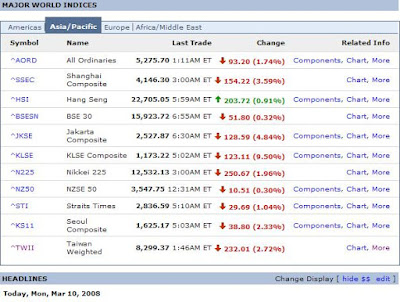
The worst job report for a number of years in the US led to a slump in all the major US indices on Friday. According to the report 63,000 jobs were taken away in March. Of course, since the US markets tumbled on Friday, most of the Asian markets (with the exception of Hong Kong) went down today.

The Malaysian Market led them down dropping more than 9%. Australia was down 1.74%, Shanghai down 3.59%, Jakarta down 4.73%, the Nikkei down 1.96% the Straits times down 1.02% and the Seoul Composite down 2.33%. Taipei’s index was down 2.72% at the close.


(Asian Market Indices for March 10, 2008, Source: Yahoo Finance)

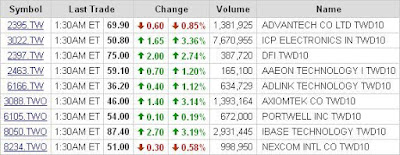
Despite these dramatic declines, the share prices for most industrial PC (IPC) companies listed on either the Taiwan Market or Over the Counter Market went up. The only one to go down (and only by 0.85%) was Advantech. ICP Electronics rose by 3.36%, DFI by 2.74%, Axiomtek by 3.14% and IBASE by 3.19%.


(Industrial PC Company Share Prices in Taiwan, March 10 2008)

These rising share prices may indicate the nature of this market. Most of their clients (system integrators and system developers) plan their projects on a one to three year time scale. The IPC companies are therefore assured of revenue streams in the future and are less exposed to short-term fluctuations in the economies.

I have no doubt that if the indicators remain bad the system integrators and developers will need to cut back on their expenditure. This would then lead to declining share prices for the IPC companies.
Here’s to hoping they carry on rising tomorrow!

08 March 2008

Taiwanese Investment in China: Now and the Future

Over the years Taiwan corporations have continued to remain competitive by moving manufacturing operations to low cost countries like China, Vietnam, Thailand, and Cambodia etc. However a large bulk of these investments have been into China.

Between 1991 and 2007, Taiwan approved US$65 billion worth of investments in China and probably much more in unreported investments. Last year alone investments from Taiwan into China amounted to US$10 billion. In December alone investments had a 22.6% year on year increase to US$1.52 billion. (Source: Reuters)

Many of the hi-tech companies have invested in manufacturing plants since this is their strength. The whole chain of sourcing raw materials, product design, marketing, manufacturing and supply chain management is highly integrated in the Taiwan market, and Taiwanese companies do it well. However, with many of these companies moving their manufacturing operations overseas, much of their expertise has been transferred. These movements, and the dependency on China as the low cost manufacturing base, has long concerned the Taiwan government, who would prefer these corporations diversify their investment strategies by sharing the investments among the other countries.

This level of investment has also led to a loss of manufacturing jobs and a decline in manufacturing in Taiwan. Last year (or the year before, cannot remember) I read in the Taipei Review that over the past decade the structure of Taiwan’s economy has changed significantly. The service industry is a growing sector and contributing more and more to the economic well being of the island. Some local restaurants and bookstores were even expanding internationally.

However, the loss of jobs is a concern. To help stimulate reinvestment into Taiwan, the government recently increased the investment cap for companies investing in China. The cap can be raised if the company is willing to invest more in Taiwan. The government has also decided to reduce the fines on renegade companies that invested in China without first seeking permission. They are hoping lower fines motivate these prodigal companies to return and invest in Taiwan. (Source: China Post)

It was also good to see that a major player in the memory industry, Transcend, is investing in a plant in Taiwan (Neihu). This move bucks the trend described above. Digitimes reports Transcend Chairman, Peter Su, said this plant reflects their optimism in Taiwan’s future. The new plant will be located in Neihu and is expected to be operational in Q3, 2009. (Source: DigiTimes)

The same Digitimes article refers to recent changes in labor laws in China and a reduction in the tax incentives. This will increase cost of production and, may in the future, see more Taiwanese companies staying and investing in Taiwan. It will be interesting to see how these additional costs affect Taiwan’s direct investment in China next year and whether investments will increase, as they have over the past, or if there will be any measurable effect at all.

I do however believe that in the short term, investments will continue to rise. Eventually the investments will peak but I somehow doubt that point has arrived.